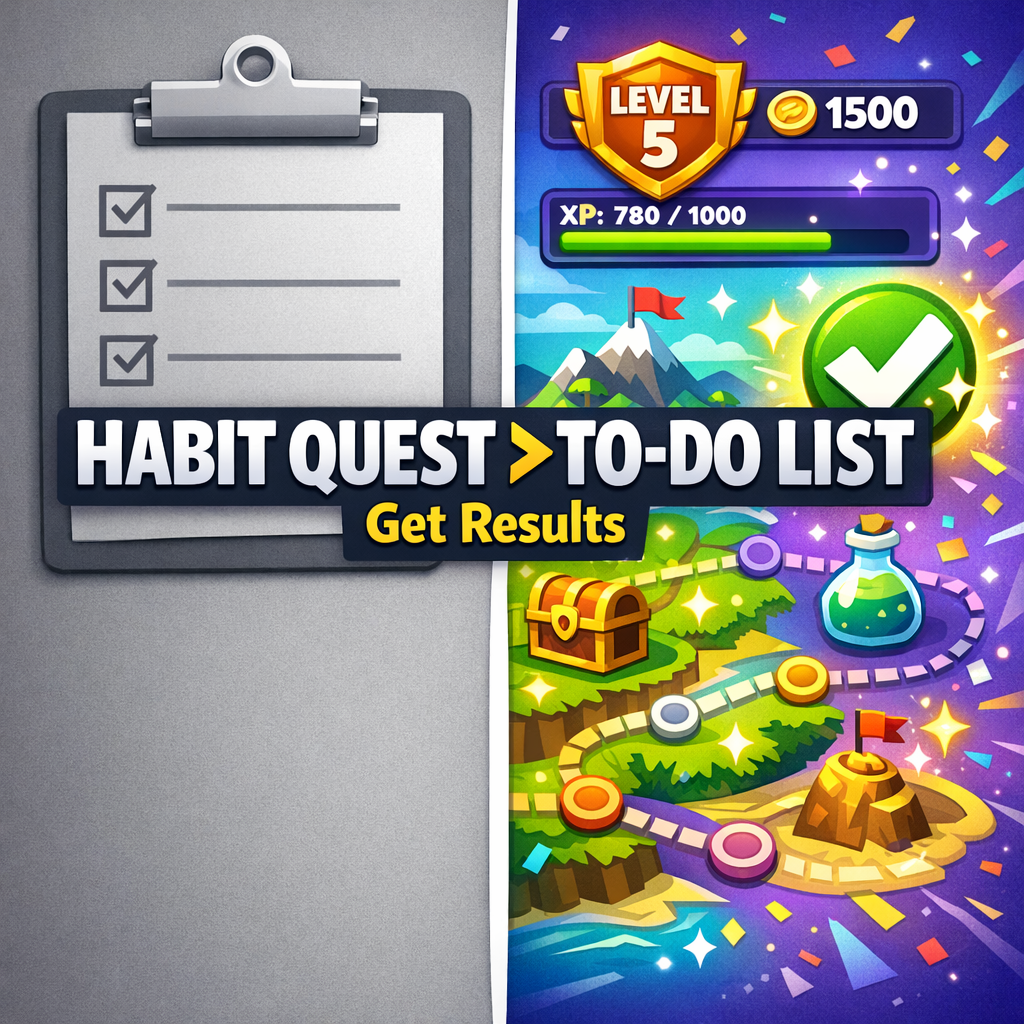
If you’re tired of long, ignored to-do lists and the motivation rollercoaster that follows, you’re not alone. Traditional checklists can be useful for errands and one-off tasks, but they often fail to change behavior—especially when your real goal is consistency.
That’s where a habit quest system comes in. Instead of a static list of items to cross off, habit quests turn habits into bite-sized challenges with rewards—XP, levels, streaks, and micro-goals—that tap into how humans stay motivated. The result is gamified productivity that feels engaging (not punishing), creates momentum, and helps you stack small wins into real outcomes.
In this post, you’ll learn why habit quests vs to-do list isn’t a fair fight, the psychology behind quest-based habit-building, and how to start using a quest system today—with practical examples for students, gym-goers, indie hackers, and anyone who wants to level up habits with a habit-tracking app like Daily Leveling.
Why traditional to-do lists fall short
A to-do checklist looks productive—until it becomes a graveyard of good intentions. Here’s why it so often fails at building lasting routines:
- No intrinsic motivation: Checking a box gives a quick dopamine ping, but there’s no system that pulls you back tomorrow. It’s completion-focused, not identity- or habit-forming.
- Overwhelm and decision fatigue: The longer the list gets, the heavier it feels. You start procrastinating, cherry-picking easy items, or avoiding it altogether.
- Missing feedback loop: A checklist rarely shows progress over time. Without visible improvement, it’s hard to stay excited about repeating the same habits.
- One-time focus, not habit formation: To-do items are designed to be done once. Most goals—fitness, studying, writing, building a product—require repetition, not “done.”
In other words, to-do lists help you manage tasks. They don’t reliably help you build streaks or turn goals into automatic behavior.
How a habit quest system works
A habit quest system reframes daily behaviors as missions you can complete for measurable rewards. Instead of “do this… eventually,” you get a clear, repeatable game plan that encourages consistency.
Here are the core mechanics that make it work:
- Quests (repeatable missions): You define habits as quests with clear criteria—like “Read 20 pages,” “Walk 8,000 steps,” or “Complete a 45-minute deep work sprint.”
- XP and level-ups: Completing quests earns XP. Accumulate enough XP and you level up, which creates a strong sense of progress and mastery.
- Streaks and rituals: Completing quests daily builds streaks. Streak-building taps into momentum and loss aversion—once you’ve built a chain, you don’t want to break it.
- Progress bars and milestones: Visual feedback makes progress obvious. Instead of guessing whether you’re improving, you can literally see it.
- Custom rewards and accountability: You can add rewards (small and meaningful) and reminders. If you share progress or compete with friends, accountability increases even more.
Why does this feel so different from a checklist? Because a quest system is designed around reinforcement. Small wins build confidence, visible progress fuels motivation, and gamified rewards make repetition satisfying—without needing constant willpower.
Benefits of habit quests vs a standard to-do list
A checklist is a tool. A quest system is a behavior engine. Here’s what you gain when you switch from “things to do” to “quests to complete.”
Sustained motivation instead of short-lived checkmarks
With a to-do list, the reward is a single check. With gamified productivity, the reward is ongoing: XP, levels, and milestones. You’re not just finishing tasks—you’re progressing in a system.
Less decision paralysis, more automatic momentum
Habit quests are pre-defined repeatable actions. That means fewer “What should I do today?” moments. When your quests are set, your next step is obvious.
Habit-forming consistency (not just completion)
A to-do checklist celebrates finishing once. A habit quest system celebrates showing up repeatedly. That’s the difference between “I worked out today” and “I’m someone who works out.”
Measurable compound growth you can actually see
Quest systems make compounding visible. For example:
- “Study 30 minutes” for 30 days isn’t just 30 checkmarks—it’s 15 hours of real learning.
- “Write 500 words” daily becomes 15,000 words a month.
- “Walk 8,000 steps” becomes a lifestyle shift, not a random burst.
Because progress is tracked through XP, streaks, and levels, you can see your effort stacking over time—one of the most powerful self-improvement tools for staying consistent.
Better prioritization via XP weighting
Not all habits are equal. In a quest system, you can assign more XP to higher-impact quests (deep work, training, shipping) and less XP to maintenance tasks. Your attention naturally shifts toward what matters.
More fun (and more likely to stick)
Let’s be honest: a checklist is rarely enjoyable. A quest system makes discipline feel like a game. That “just one more quest” effect is exactly what turns a habit-tracking app into something you want to open.
Real-world example: An indie hacker who uses a quest to “Ship one small improvement every Friday” compounds product progress and reduces launch anxiety. Compare that to a vague to-do like “Work on product” that gets postponed endlessly.
How to start using habit quests today (simple steps + examples)
You don’t need a complicated setup. Start small, make it clear, and make it repeatable.
1. Choose 3–5 core habits. Pick small, high-impact routines you can realistically repeat: study, workouts, deep work, writing, reading, meditation.
2. Turn them into quests with clear criteria. Define what “done” means (no ambiguity). Example: “One 45-minute Pomodoro” is clearer than “focus more.”
3. Assign XP and streak goals. Give bigger XP to bigger impact. Set streak targets like 7, 21, or 60 days so you’re always chasing a milestone.
4. Use visual progress tools. Track streaks, XP, and levels daily. The point is to make progress visible.
5. Reward milestones. Celebrate level-ups with small rewards: a new book, a rest day, a nice coffee, a movie night—anything that reinforces the behavior.
6. Iterate every 30 days. Adjust quest difficulty and XP as you improve. Your system should evolve with your skills.
Examples (tailored quests)
- Students
- Quest: “Study one focused hour (phone away)”
- XP: Higher XP for harder subjects or practice tests
- Goal: Build streaks to prevent cramming and create consistent recall
- Gym-goers
- Quest: “Complete today’s workout (or 20-minute minimum session)”
- XP: Extra XP for progressive overload, mobility work, or hitting protein targets
- Goal: Streak-building for consistency, with milestones for weeks/months completed
- Indie hackers / creators
- Quest: “Ship one small improvement” (feature, bug fix, landing page test)
- XP: More XP for shipping than planning (to reward output)
- Goal: Build a weekly shipping streak that compounds product momentum
The common thread: you’re not just tracking tasks—you’re using a habit quest system to design repeatable wins.
SEO notes and internal linking suggestions (for site owners)
To maximize search performance for terms like habit quest system, habit-tracking app, gamified productivity, and streak-building:
- Use the primary keywords in the H1/H2s, within the first 100 words, and naturally throughout the post.
- Add internal links to:
- https://www.dailyleveling.app (homepage)
- A features page (habit quests, streaks, XP, leveling)
- Related article: “How XP and Leveling Improve Motivation” (or similar)
Conclusion: stop checking boxes—start leveling up
A habit quest system converts discipline into play: repeated action becomes visible progress, boredom becomes momentum, and goals become quests you can actually finish. Ready to build streaks, earn XP, and turn self-improvement into a game? Try Daily Leveling at https://www.dailyleveling.app and start your first quest today.
Social post copy:
“Tired of boring to-do lists? Turn habits into quests, earn XP, and level up your life. Start building streaks with Daily Leveling — download now: https://www.dailyleveling.app”